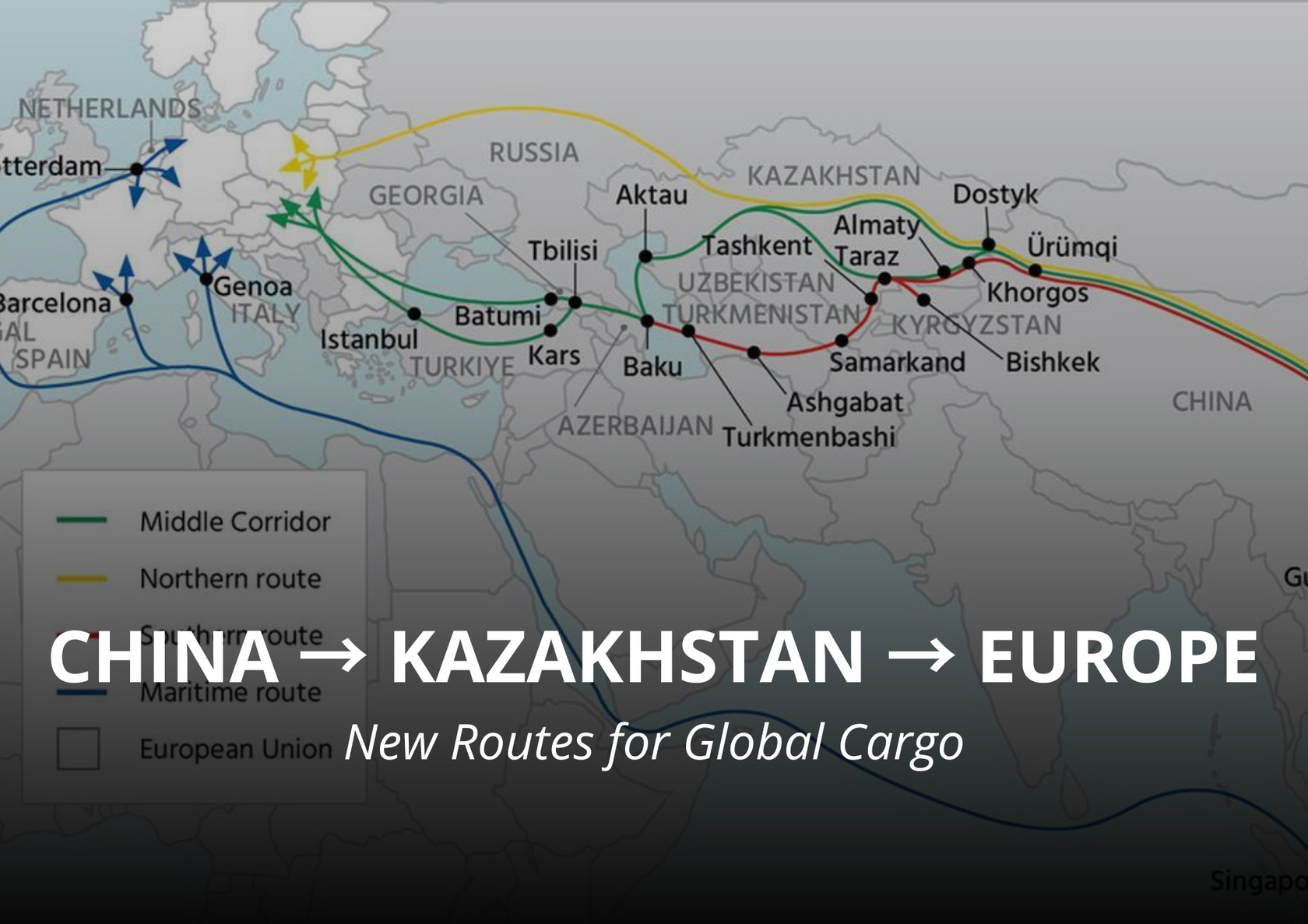
China – Kazakhstan – Europe: How Freight Routes Are Changing
Transport links between China and Kazakhstan continue to develop, creating new opportunities for international freight transportation. In 2026, the countries are expanding railway capacity, developing road routes, border infrastructure, ports and air cargo facilities.
In the first half of 2026, the volume of freight transportation between Kazakhstan and China reached 18.7 million tonnes, an increase of 9% compared with the same period last year. The growth in cargo volumes is accompanied by the development of new transport solutions and the expansion of existing infrastructure.
For businesses, the key takeaway is simple: freight routes can increasingly be selected based on the type of cargo, required transit time, volume and budget.
From China to the Caspian Sea: How the Route Is Developing
One of the key directions remains the connection between China and Kazakhstan through border crossings and logistics hubs. The existing transport network includes logistics facilities and terminals in Lianyungang, Khorgos, Xi'an, Almaty and Aktau. The network is expected to expand further, including through the development of a new Kazakhstan–China logistics terminal in Chengdu.
At the same time, the Middle Corridor, also known as the Trans-Caspian International Transport Route, continues to develop as a link between China and Europe through Kazakhstan, the Caspian Sea, Azerbaijan and Georgia.
The route can be presented as:
China → Kazakhstan → Aktau → Caspian Sea → Azerbaijan → Georgia → Europe
For cargo owners, this provides an additional option for moving goods between Asian and European markets. At the same time, the route may involve several modes of transport and requires coordination at different stages of the shipment.
What Freight Options Are Available for Businesses?
The most suitable transportation method depends primarily on the characteristics of the cargo.
Road transportation is suitable for shipments that require flexibility and door-to-door delivery, particularly when the origin and destination can be connected efficiently by road.
Rail transportation can be an effective option for larger and regular cargo volumes. The development of railway infrastructure between Kazakhstan and China is expected to increase the capacity of existing routes.
One of the important projects is the construction of the Bakhty – Ayagoz railway line. Once completed, the project is expected to create a third railway crossing between Kazakhstan and China and increase the transport corridor's capacity to 25 million tonnes of cargo per year.
Multimodal transportation combines several modes of transport within a single logistics solution. For example, cargo can move from China to Kazakhstan by rail and then continue by road to its final destination.
For urgent or smaller shipments, air freight remains an important option, allowing businesses to significantly reduce transit time.
Why One Route Does Not Work for Every Shipment
The development of transport infrastructure does not mean that there is one universal route for every type of cargo.
For one shipment, road transportation through Khorgos may be the most suitable solution. Another shipment may be better suited to rail transportation. If delivery speed is the priority, air freight may be considered.
When selecting a route, it is important to consider more than just the freight rate. Transit time, the number of cargo handling points, cargo characteristics, packaging requirements, customs clearance and final-mile delivery can all affect the overall logistics solution.
That is why international freight transportation starts not with choosing a mode of transport, but with analysing the entire logistics chain.
What Does This Mean for China → Kazakhstan Freight?
The development of transport infrastructure between China and Kazakhstan is creating more opportunities for international freight transportation. Cargo flows already pass through key routes such as Dostyk and Altynkol, while the development of new railway lines and logistics centres is expected to further increase capacity.
For companies importing goods from China, this means that several transportation options can be considered instead of relying on a single route.
At Nomad Tranzit, we select the transportation solution according to the specific requirements of each shipment — including weight, volume, destination, required transit time and budget. We can arrange road, rail, air and multimodal transportation and coordinate cargo throughout the entire logistics process.
The development of transport corridors is changing not only infrastructure but also the way international logistics is organised: the more routes become available, the more important it is to select the one that best fits the specific shipment.